Slack Integration
| Version | 1.34.0 (View all) |
| Managed integration release status | GA |
| Subscription level What's this? |
Basic |
| Developed by What's this? |
Elastic |
| Ingestion method(s) | API |
| Minimum Kibana version(s) | 9.1.4 9.0.7 8.19.4 |
You can use this integration as an Elastic Managed integration on Elastic Cloud Hosted deployments running this version or later.
Slack is used by numerous orgazations as their primary chat and collaboration tool.
The Slack integration uses Slack's API to retrieve audit events and a user inventory, and ingest them into Elasticsearch. This allows you to search, observe, and visualize the Slack log events through Elasticsearch.
The Elastic agent running this integration interacts with Slack's infrastructure using their APIs to retrieve audit logs, Enterprise Grid users, and user groups.
Please note these APIs are only available to Slack workspaces on an Enterprise Grid plan. These API methods will not work for workspaces on a Free, Standard, or Business+ plan.
Elastic Managed integrations are only supported on Elastic Cloud Serverless and Elastic Cloud Hosted deployments. An Elastic Managed integration lets you ingest data from a cloud source while avoiding the orchestration, management, and maintenance associated with standard ingest infrastructure. Elastic runs the collector for you, so you can focus on your data instead of the infrastructure that collects it.
For more information, refer to Elastic Managed integrations and the Elastic Managed integrations FAQ.
- In Kibana go to Management > Integrations
- In the "Search for integrations" search bar type Slack.
- Click on "Slack" integration from the search results.
- Click on Add Slack button to add Slack integration.
Enter values "OAuth API Token".
- OAuth API Token will be generated when a Slack App is created.
For the Slack integration to be able to successfully get logs the following "User Token Scopes" must be granted to the Slack App:
- Audit logs:
auditlogs:read - Users:
admin.users:read - User groups:
usergroups:read
The audit and users streams each have their own token. You can use one Slack app token that has all required scopes, or a separate token per stream. The users stream needs both admin.users:read and usergroups:read.
Audit logs summarize the history of changes made within the Slack Enterprise.
Exported fields
| Field | Description | Type |
|---|---|---|
| @timestamp | Event timestamp. | date |
| cloud.image.id | Image ID for the cloud instance. | keyword |
| data_stream.dataset | Data stream dataset name. | constant_keyword |
| data_stream.namespace | Data stream namespace. | constant_keyword |
| data_stream.type | Data stream type. | constant_keyword |
| event.dataset | Event dataset | constant_keyword |
| event.module | Event module | constant_keyword |
| host.containerized | If the host is a container. | boolean |
| host.os.build | OS build information. | keyword |
| host.os.codename | OS codename, if any. | keyword |
| input.type | Type of Filebeat input. | keyword |
| log.flags | Flags for the log file. | keyword |
| log.offset | Offset of the entry in the log file. | long |
| slack.audit.actor.type | The type of entity performing the action. | keyword |
| slack.audit.actor.user.team | The the team of the actor if they are a user. | keyword |
| slack.audit.context.domain | The domain of the Workspace or Enterprise | keyword |
| slack.audit.context.id | The ID of the workspace or enterprise | keyword |
| slack.audit.context.name | The name of the workspace or enterprise | keyword |
| slack.audit.context.session_id | The identifier that is unique to each authenticated session. | keyword |
| slack.audit.context.type | The type of account. Either Workspace or Enterprise |
keyword |
| slack.audit.details.arguments | The arguments an AI app passed to a Slack MCP server tool when event.action ends in _tool_called. The shape depends on the tool, so nested keys are stored as dotted leaf fields. |
object |
| slack.audit.details.location | The location the activity occured in when event.action is anomaly | keyword |
| slack.audit.details.md5 | The md5 hash of a file associated with a file_malicious_content_detected event. |
keyword |
| slack.audit.details.previous_ip_address | The IP address previously observed for the entity in the event when event.action is anomaly | ip |
| slack.audit.details.previous_user_agent | The User-Agent string previously observed for the entity in the event when event.action is anomaly | keyword |
| slack.audit.details.reason | The anomaly rule triggered to generate the event when event.action is anomaly: asn, excessive_downloads, ip_address, session_fingerprint, tor, user_agent | keyword |
| slack.audit.details.tool | The Slack MCP server tool an AI app called when event.action ends in _tool_called. |
keyword |
| slack.audit.details.url_private | URL associated with the action. | keyword |
| slack.audit.entity.barriered_from_usergroup | The user group barrier when entity_type is barrier | keyword |
| slack.audit.entity.channel | The channel the entity is within when entity_type is message | keyword |
| slack.audit.entity.domain | Domain of the entity when entity_type is Workspace or Enterprise | keyword |
| slack.audit.entity.email | Email address of the entity when entity_type is user | keyword |
| slack.audit.entity.entity_type | Type of the entity: workspace, enterprise, user, file, channel, app, workflow, user, usergroup, barrier, message, role, account_type_role. | keyword |
| slack.audit.entity.filetype | Filetype of the entity when entity_type is file | keyword |
| slack.audit.entity.id | ID of the entity | keyword |
| slack.audit.entity.is_directory_approved | If App is approved when entity_type is app | boolean |
| slack.audit.entity.is_distributed | If App is distributed when entity_type is app | boolean |
| slack.audit.entity.is_org_shared | If channel is shared when entity_type is channel | boolean |
| slack.audit.entity.is_shared | If channel is shared when entity_type is channel | boolean |
| slack.audit.entity.is_workflow_app | If App is a workflow when entity_type is app | boolean |
| slack.audit.entity.name | Name of the entity | keyword |
| slack.audit.entity.primary_usergroup | The primary user group when entity_type is barrier | keyword |
| slack.audit.entity.privacy | Privacy status of entity when entity_type is channel | keyword |
| slack.audit.entity.scopes | The OAuth scopes when entity_type is app | keyword |
| slack.audit.entity.team | Team that the entity exists within when entity_type is user or message | keyword |
| slack.audit.entity.teams_shared_with | List of orgs channel is shared with when entity_type is channel | keyword |
| slack.audit.entity.timestamp | The timestamp of the entity when entity_type is message | keyword |
| slack.audit.entity.title | Title of the entity when entity_type is file | keyword |
| slack.audit.entity.type | The type of the entity when entity_type is role | keyword |
Example
{
    "@timestamp": "2023-01-13T17:40:21.862Z",
    "agent": {
        "ephemeral_id": "4493e0ba-0e9b-43e7-ad59-2a2c6c330c73",
        "id": "6790db85-6c1f-425a-a093-87887eed5a5d",
        "name": "elastic-agent-86233",
        "type": "filebeat",
        "version": "8.19.4"
    },
    "data_stream": {
        "dataset": "slack.audit",
        "namespace": "54041",
        "type": "logs"
    },
    "ecs": {
        "version": "9.5.0"
    },
    "elastic_agent": {
        "id": "6790db85-6c1f-425a-a093-87887eed5a5d",
        "snapshot": false,
        "version": "8.19.4"
    },
    "event": {
        "action": "anomaly",
        "agent_id_status": "verified",
        "created": "2025-12-05T07:31:29.085Z",
        "dataset": "slack.audit",
        "id": "2125fb41-c67c-4cf5-a5c4-d90cb58dd5f9",
        "ingested": "2025-12-05T07:31:30Z",
        "kind": "event",
        "original": "{\"action\":\"anomaly\",\"actor\":{\"type\":\"user\",\"user\":{\"email\":\"aaron@example.com\",\"id\":\"e65b0f5c\",\"name\":\"roy\"}},\"context\":{\"ip_address\":\"81.2.69.143\",\"location\":{\"domain\":\"Docker\",\"id\":\"e65b11aa\",\"name\":\"Docker\",\"type\":\"workspace\"},\"ua\":\"Mozilla/5.0 (Windows NT 6.1; Win64; x64; rv:23.0) Gecko/20131011 Firefox/23.0\"},\"date_create\":1683836273,\"details\":{\"action_timestamp\":1673631621862,\"location\":\"England, GB\",\"previous_ip_address\":\"175.16.199.64\",\"previous_ua\":\"\",\"reason\":[\"asn\",\"ip_address\"]},\"entity\":{\"type\":\"user\",\"user\":{\"email\":\"jbob@example.com\",\"id\":\"asdfasdf\",\"name\":\"Joe Bob\",\"team\":\"T234SAH2\"}},\"id\":\"2125fb41-c67c-4cf5-a5c4-d90cb58dd5f9\"}",
        "type": [
            "info"
        ]
    },
    "input": {
        "type": "httpjson"
    },
    "related": {
        "ip": [
            "81.2.69.143"
        ],
        "user": [
            "e65b0f5c",
            "aaron@example.com"
        ]
    },
    "slack": {
        "audit": {
            "actor": {
                "type": "user"
            },
            "context": {
                "domain": "Docker",
                "id": "e65b11aa",
                "name": "Docker",
                "type": "workspace"
            },
            "details": {
                "location": "England, GB",
                "previous_ip_address": "175.16.199.64",
                "reason": [
                    "asn",
                    "ip_address"
                ]
            },
            "entity": {
                "email": "jbob@example.com",
                "entity_type": "user",
                "id": "asdfasdf",
                "name": "Joe Bob",
                "team": "T234SAH2"
            }
        }
    },
    "source": {
        "address": "81.2.69.143",
        "geo": {
            "city_name": "London",
            "continent_name": "Europe",
            "country_iso_code": "GB",
            "country_name": "United Kingdom",
            "location": {
                "lat": 51.5142,
                "lon": -0.0931
            },
            "region_iso_code": "GB-ENG",
            "region_name": "England"
        },
        "ip": "81.2.69.143"
    },
    "tags": [
        "forwarded",
        "slack-audit",
        "preserve_original_event"
    ],
    "user": {
        "email": "aaron@example.com",
        "full_name": "roy",
        "id": "e65b0f5c"
    },
    "user_agent": {
        "device": {
            "name": "Other"
        },
        "name": "Firefox",
        "original": "Mozilla/5.0 (Windows NT 6.1; Win64; x64; rv:23.0) Gecko/20131011 Firefox/23.0",
        "os": {
            "full": "Windows 7",
            "name": "Windows",
            "version": "7"
        },
        "version": "23.0"
    }
}
The users data stream collects a daily snapshot of Slack Enterprise Grid user accounts from admin.users.list. Each document is one user, for Elastic Security entity analytics.
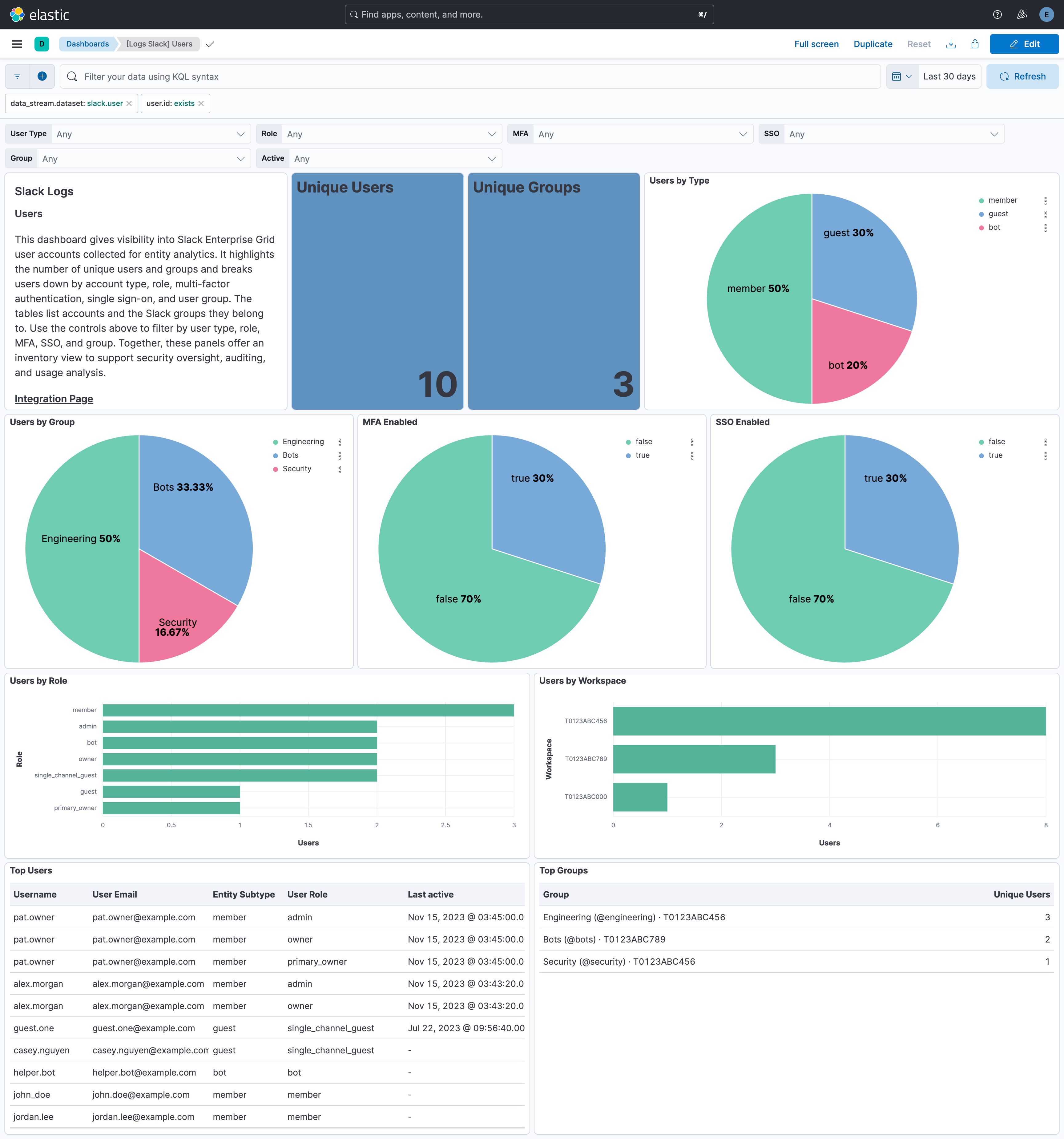
It then collects user groups from usergroups.list for each workspace on those users, and attaches matching groups to slack.user.groups. The [Logs Slack] Users dashboard includes user and group panels.
The token must be an org-level user token (xoxp-) with the admin.users:read and usergroups:read scopes. The app must be installed on the Enterprise organization, not on a single workspace.
Each collection walks admin.users.list twice (is_active=true, then is_active=false) so a snapshot includes both active and deactivated accounts.
Exported fields
| Field | Description | Type |
|---|---|---|
| @timestamp | Date/time when the event originated. This is the date/time extracted from the event, typically representing when the event was generated by the source. If the event source has no original timestamp, this value is typically populated by the first time the event was received by the pipeline. Required field for all events. | date |
| cloud.image.id | Image ID for the cloud instance. | keyword |
| data_stream.dataset | The field can contain anything that makes sense to signify the source of the data. Examples include nginx.access, prometheus, endpoint etc. For data streams that otherwise fit, but that do not have dataset set we use the value "generic" for the dataset value. event.dataset should have the same value as data_stream.dataset. Beyond the Elasticsearch data stream naming criteria noted above, the dataset value has additional restrictions: * Must not contain - * No longer than 100 characters |
constant_keyword |
| data_stream.namespace | A user defined namespace. Namespaces are useful to allow grouping of data. Many users already organize their indices this way, and the data stream naming scheme now provides this best practice as a default. Many users will populate this field with default. If no value is used, it falls back to default. Beyond the Elasticsearch index naming criteria noted above, namespace value has the additional restrictions: * Must not contain - * No longer than 100 characters |
constant_keyword |
| data_stream.type | An overarching type for the data stream. Currently allowed values are "logs" and "metrics". We expect to also add "traces" and "synthetics" in the near future. | constant_keyword |
| ecs.version | ECS version this event conforms to. ecs.version is a required field and must exist in all events. When querying across multiple indices -- which may conform to slightly different ECS versions -- this field lets integrations adjust to the schema version of the events. |
keyword |
| error.code | Error code describing the error. | keyword |
| error.id | Unique identifier for the error. | keyword |
| error.message | Error message. | match_only_text |
| event.category | This is one of four ECS Categorization Fields, and indicates the second level in the ECS category hierarchy. event.category represents the "big buckets" of ECS categories. For example, filtering on event.category:process yields all events relating to process activity. This field is closely related to event.type, which is used as a subcategory. This field is an array. This will allow proper categorization of some events that fall in multiple categories. |
keyword |
| event.dataset | Name of the dataset. If an event source publishes more than one type of log or events (e.g. access log, error log), the dataset is used to specify which one the event comes from. It's recommended but not required to start the dataset name with the module name, followed by a dot, then the dataset name. | constant_keyword |
| event.kind | This is one of four ECS Categorization Fields, and indicates the highest level in the ECS category hierarchy. event.kind gives high-level information about what type of information the event contains, without being specific to the contents of the event. For example, values of this field distinguish alert events from metric events. The value of this field can be used to inform how these kinds of events should be handled. They may warrant different retention, different access control, it may also help understand whether the data is coming in at a regular interval or not. |
keyword |
| event.module | Name of the module this data is coming from. If your monitoring agent supports the concept of modules or plugins to process events of a given source (e.g. Apache logs), event.module should contain the name of this module. |
constant_keyword |
| event.original | Raw text message of entire event. Used to demonstrate log integrity or where the full log message (before splitting it up in multiple parts) may be required, e.g. for reindex. This field is not indexed and doc_values are disabled. It cannot be searched, but it can be retrieved from _source. If users wish to override this and index this field, please see Field data types in the Elasticsearch Reference. |
keyword |
| event.type | This is one of four ECS Categorization Fields, and indicates the third level in the ECS category hierarchy. event.type represents a categorization "sub-bucket" that, when used along with the event.category field values, enables filtering events down to a level appropriate for single visualization. This field is an array. This will allow proper categorization of some events that fall in multiple event types. |
keyword |
| host.containerized | If the host is a container. | boolean |
| host.os.build | OS build information. | keyword |
| host.os.codename | OS codename, if any. | keyword |
| input.type | Type of filebeat input. | keyword |
| log.offset | Log offset. | long |
| related.user | All the user names or other user identifiers seen on the event. | keyword |
| slack.user.date_created | When the Slack account was created. | date |
| slack.user.deactivated_ts | When the Slack account was deactivated. Absent when Slack sends 0. | date |
| slack.user.expiration_ts | When a guest account expires. Absent when Slack sends 0. | date |
| slack.user.groups.auto_type | Automatic user group type, such as admin or owner, when Slack sets one. | keyword |
| slack.user.groups.created_by | Slack user ID that created the user group. | keyword |
| slack.user.groups.date_create | When the user group was created. | date |
| slack.user.groups.date_delete | When the user group was deleted. Absent when Slack sends 0. | date |
| slack.user.groups.date_update | When the user group was last updated. | date |
| slack.user.groups.deleted_by | Slack user ID that deleted the user group. | keyword |
| slack.user.groups.description | User group description. | keyword |
| slack.user.groups.handle | User group mention handle. | keyword |
| slack.user.groups.id | Slack user group ID. | keyword |
| slack.user.groups.is_external | Whether the user group is external. | boolean |
| slack.user.groups.is_usergroup | Whether this object is a Slack user group. | boolean |
| slack.user.groups.label | Combined group name, handle, and workspace ID, used so dashboards keep those attributes paired. | keyword |
| slack.user.groups.name | User group name. | keyword |
| slack.user.groups.prefs.channels | Default public channel IDs for the user group. | keyword |
| slack.user.groups.prefs.groups | Default private channel IDs for the user group. | keyword |
| slack.user.groups.team_id | Workspace ID the user group belongs to. | keyword |
| slack.user.groups.updated_by | Slack user ID that last updated the user group. | keyword |
| slack.user.groups.user_count | Number of users in the user group, as returned by Slack. | keyword |
| slack.user.has_2fa | Whether the user has two-factor authentication enabled. Copied to user.entity.attributes.mfa_enabled. | boolean |
| slack.user.has_sso | Whether the user signs in with single sign-on. | boolean |
| slack.user.is_active | Whether the Slack account is active. Deactivated accounts are false. | boolean |
| slack.user.is_admin | Whether the user is an admin. | boolean |
| slack.user.is_bot | Whether the account is a bot. | boolean |
| slack.user.is_owner | Whether the user is an owner. | boolean |
| slack.user.is_primary_owner | Whether the user is the primary owner. | boolean |
| slack.user.is_restricted | Whether the user is a guest. | boolean |
| slack.user.is_ultra_restricted | Whether the user is a single-channel guest. | boolean |
| slack.user.last_active_ts | When Slack last recorded activity for the user. Copied to user.entity.lifecycle.last_activity. | date |
| slack.user.role_names | Slack admin role names translated from known role IDs. | keyword |
| slack.user.roles | Slack admin role IDs assigned to the user, when the API returns them. | keyword |
| slack.user.workspaces | Workspace IDs the user belongs to. | keyword |
| tags | List of keywords used to tag each event. | keyword |
| user.email | User email address. | keyword |
| user.entity.attributes.mfa_enabled | Indicates whether multi-factor authentication is enabled for this entity. Typically applicable to User entities. | boolean |
| user.entity.display_name | An optional field used when a pretty name is desired for entity-centric operations. This field should not be used for correlation with \*.name fields for entities with dedicated field sets (for example, host). |
keyword |
| user.entity.display_name.text | Multi-field of user.entity.display_name. |
match_only_text |
| user.entity.id | A unique identifier for the entity. When multiple identifiers exist, this should be the most stable and commonly used identifier that: 1) persists across the entity's lifecycle, 2) ensures uniqueness within its scope, 3) is commonly used for queries and correlation, and 4) is readily available in most observations (logs/events). For entities with dedicated field sets (for example, host, user), this value should match the corresponding *.id field. Alternative identifiers (for example, ARNs values in AWS, URLs) can be preserved in the raw field. | keyword |
| user.entity.last_seen_timestamp | Indicates the date/time when this entity was last "seen," usually based upon the last event/log that is initiated by this entity. | date |
| user.entity.lifecycle.last_activity | Timestamp of the most recent action performed by or attributed to this entity (active use). Distinct from entity.last_seen_timestamp, which records when the entity was last observed in data; last_activity implies the entity was active, not only seen. Typically applicable to User, Host, and Service entities. |
date |
| user.entity.name | The name of the entity. The keyword field enables exact matches for filtering and aggregations, while the text field enables full-text search. For entities with dedicated field sets (for example, host), this field should mirrors the corresponding *.name value. |
keyword |
| user.entity.name.text | Multi-field of user.entity.name. |
match_only_text |
| user.entity.source | The module or integration that provided this entity data (similar to event.module). | keyword |
| user.entity.sub_type | The specific type designation for the entity as defined by its provider or system. This field provides more granular classification than the type field. Examples: aws_s3_bucket, gcp_cloud_storage_bucket, azure_blob_container would all map to entity type bucket. hardware , virtual , container , node , cloud_instance would all map to entity type host. |
keyword |
| user.entity.type | A standardized high-level classification of the entity. This provides a normalized way to group similar entities across different providers or systems. Example values: bucket, database, container, function, queue, host, user, application, session, cloud, orchestrator, etc. If an entity is nested under a top-level namespace like host or cloud, or similar, its type array should include the matching value — for example, host or cloud. |
keyword |
| user.full_name | User's full name, if available. | keyword |
| user.full_name.text | Multi-field of user.full_name. |
match_only_text |
| user.group.id | Unique identifier for the group on the system/platform. | keyword |
| user.group.name | Name of the group. | keyword |
| user.id | Unique identifier of the user. | keyword |
| user.name | Short name or login of the user. | keyword |
| user.name.text | Multi-field of user.name. |
match_only_text |
| user.roles | Array of user roles at the time of the event. | keyword |
Example
{
    "@timestamp": "2026-10-29T09:05:16.637Z",
    "agent": {
        "ephemeral_id": "f7065e09-c62a-4d89-871c-285a7f7bc5d7",
        "id": "8584a241-b697-40e9-bc0e-146a6c3492a9",
        "name": "elastic-agent-12629",
        "type": "filebeat",
        "version": "8.19.4"
    },
    "data_stream": {
        "dataset": "slack.user",
        "namespace": "92443",
        "type": "logs"
    },
    "ecs": {
        "version": "9.5.0"
    },
    "elastic_agent": {
        "id": "8584a241-b697-40e9-bc0e-146a6c3492a9",
        "snapshot": false,
        "version": "8.19.4"
    },
    "event": {
        "agent_id_status": "verified",
        "category": [
            "iam"
        ],
        "dataset": "slack.user",
        "ingested": "2026-10-29T09:05:17Z",
        "kind": "asset",
        "original": "{\"date_created\":1566922090,\"deactivated_ts\":0,\"email\":\"alex.morgan@example.com\",\"expiration_ts\":0,\"full_name\":\"Alex Morgan\",\"groups\":[{\"auto_type\":null,\"created_by\":\"W0123ABC001\",\"date_create\":1446598059,\"date_delete\":0,\"date_update\":1446670362,\"deleted_by\":null,\"description\":\"Engineering team for the Elastic workspace.\",\"handle\":\"engineering\",\"id\":\"S0614TZR7\",\"is_external\":false,\"is_usergroup\":true,\"name\":\"Engineering\",\"prefs\":{\"channels\":[],\"groups\":[]},\"team_id\":\"T0123ABC456\",\"updated_by\":\"W0123ABC001\",\"user_count\":\"3\"},{\"auto_type\":\"admin\",\"created_by\":\"USLACKBOT\",\"date_create\":1446678371,\"date_delete\":0,\"date_update\":1446678371,\"deleted_by\":null,\"description\":\"Security reviewers.\",\"handle\":\"security\",\"id\":\"S06158AV7\",\"is_external\":false,\"is_usergroup\":true,\"name\":\"Security\",\"prefs\":{\"channels\":[],\"groups\":[]},\"team_id\":\"T0123ABC456\",\"updated_by\":\"USLACKBOT\",\"user_count\":\"1\"}],\"has_2fa\":true,\"has_sso\":true,\"id\":\"W0123ABC001\",\"is_active\":true,\"is_admin\":true,\"is_bot\":false,\"is_owner\":true,\"is_primary_owner\":false,\"is_restricted\":false,\"is_ultra_restricted\":false,\"last_active_ts\":1700000000,\"roles\":[\"Rl0J\"],\"username\":\"alex.morgan\",\"workspaces\":[\"T0123ABC456\"]}",
        "type": [
            "user",
            "info"
        ]
    },
    "input": {
        "type": "cel"
    },
    "related": {
        "user": [
            "alex.morgan",
            "Alex Morgan",
            "alex.morgan@example.com",
            "W0123ABC001"
        ]
    },
    "slack": {
        "user": {
            "date_created": "2019-08-27T16:08:10.000Z",
            "groups": [
                {
                    "created_by": "W0123ABC001",
                    "date_create": "2015-11-04T00:47:39Z",
                    "date_update": "2015-11-04T20:52:42Z",
                    "description": "Engineering team for the Elastic workspace.",
                    "handle": "engineering",
                    "id": "S0614TZR7",
                    "is_external": false,
                    "is_usergroup": true,
                    "label": "Engineering (@engineering) · T0123ABC456",
                    "name": "Engineering",
                    "team_id": "T0123ABC456",
                    "updated_by": "W0123ABC001",
                    "user_count": "3"
                },
                {
                    "auto_type": "admin",
                    "created_by": "USLACKBOT",
                    "date_create": "2015-11-04T23:06:11Z",
                    "date_update": "2015-11-04T23:06:11Z",
                    "description": "Security reviewers.",
                    "handle": "security",
                    "id": "S06158AV7",
                    "is_external": false,
                    "is_usergroup": true,
                    "label": "Security (@security) · T0123ABC456",
                    "name": "Security",
                    "team_id": "T0123ABC456",
                    "updated_by": "USLACKBOT",
                    "user_count": "1"
                }
            ],
            "has_2fa": true,
            "has_sso": true,
            "is_active": true,
            "is_admin": true,
            "is_bot": false,
            "is_owner": true,
            "is_primary_owner": false,
            "is_restricted": false,
            "is_ultra_restricted": false,
            "last_active_ts": "2023-11-14T22:13:20.000Z",
            "roles": [
                "Rl0J"
            ],
            "workspaces": [
                "T0123ABC456"
            ]
        }
    },
    "tags": [
        "preserve_original_event",
        "forwarded",
        "slack-user"
    ],
    "user": {
        "email": "alex.morgan@example.com",
        "entity": {
            "attributes": {
                "mfa_enabled": true
            },
            "display_name": "Alex Morgan",
            "id": "W0123ABC001",
            "last_seen_timestamp": "2026-10-29T09:05:16.637Z",
            "lifecycle": {
                "last_activity": "2023-11-14T22:13:20.000Z"
            },
            "name": "alex.morgan",
            "source": "slack",
            "sub_type": [
                "member"
            ],
            "type": [
                "user"
            ]
        },
        "full_name": "Alex Morgan",
        "id": "W0123ABC001",
        "name": "alex.morgan",
        "roles": [
            "owner",
            "admin"
        ]
    }
}
This integration includes one or more Kibana dashboards that visualizes the data collected by the integration. The screenshots below illustrate how the ingested data is displayed.
Changelog
| Version | Details | Minimum Kibana version |
|---|---|---|
| 1.34.0 | Enhancement (View pull request) Add a user data stream that collects Slack Enterprise Grid users for entity analytics. Updates the ECS reference to 9.5.0 for the ECS entity fields, which also sets ecs.version 9.5.0 on audit events. |
9.1.4 9.0.7 8.19.4 |
| 1.33.0 | Enhancement (View pull request) Update Elastic Managed integration documentation to the current wording and docs links. |
9.1.4 9.0.7 8.19.4 |
| 1.32.2 | Bug fix (View pull request) Fix documents rejected when Slack MCP server tool call arguments in details.arguments change shape between events, and declare details.tool. |
9.1.4 9.0.7 8.19.4 |
| 1.32.1 | Bug fix (View pull request) Fix handling of empty value for details.previous_ip_address field. |
9.1.4 9.0.7 8.19.4 |
| 1.32.0 | Enhancement (View pull request) Enable request trace log removal. |
9.1.4 9.0.7 8.19.4 |
| 1.31.0 | Enhancement (View pull request) Add tags to ingest pipeline processors and add preserve_original_event to pipeline-level on_failure handlers. |
9.1.4 9.0.7 8.19.4 |
| 1.30.1 | Enhancement (View pull request) Set agentless deployment mode release field to ga. |
9.1.4 9.0.7 8.19.4 |
| 1.30.0 | Enhancement (View pull request) Set 'elastic' owner type. |
9.1.4 9.0.7 8.19.4 |
| 1.29.0 | Enhancement (View pull request) Reorganize variable to hide advanced variables and make agentless the default deployment mode. |
9.1.4 9.0.7 8.19.4 |
| 1.28.0 | Enhancement (View pull request) Use new release field for agentless deployment mode to establish as beta. |
9.1.4 9.0.7 8.19.4 |
| 1.27.0 | Enhancement (View pull request) Enable Agentless deployment. |
9.1.4 9.0.7 8.19.4 |
| 1.26.0 | Enhancement (View pull request) Prevent updating fleet health status to degraded when the next_cursor is not present. |
9.1.4 9.0.7 8.19.4 |
| 1.25.1 | Bug fix (View pull request) Fix handling of empty Slack context.ip_address fields. |
9.0.0 8.13.0 |
| 1.25.0 | Enhancement (View pull request) Update Kibana constraint to support 9.0.0. |
9.0.0 8.13.0 |
| 1.24.1 | Bug fix (View pull request) Updated SSL description in package manifest.yml to be uniform and to include links to documentation. |
8.13.0 |
| 1.24.0 | Enhancement (View pull request) Do not remove event.original in main ingest pipeline. |
8.13.0 |
| 1.23.0 | Enhancement (View pull request) Add "preserve_original_event" tag to documents with event.kind set to "pipeline_error". |
8.13.0 |
| 1.22.0 | Enhancement (View pull request) Map details.url_private and actor fields.Enhancement (View pull request) Improve pipeline efficiency. |
8.13.0 |
| 1.21.2 | Bug fix (View pull request) Use triple-brace Mustache templating when referencing variables in ingest pipelines. |
8.13.0 |
| 1.21.1 | Bug fix (View pull request) Use triple-brace Mustache templating when referencing variables in ingest pipelines. |
8.13.0 |
| 1.21.0 | Enhancement (View pull request) Update the kibana constraint to ^8.13.0. Modified the field definitions to remove ECS fields made redundant by the ecs@mappings component template. |
8.13.0 |
| 1.20.0 | Enhancement (View pull request) Improve handling of empty responses. |
8.12.0 |
| 1.19.0 | Enhancement (View pull request) Map md5 hash detail for files. |
8.12.0 |
| 1.18.0 | Enhancement (View pull request) Set sensitive values as secret. |
8.12.0 |
| 1.17.1 | Enhancement (View pull request) Changed owners |
8.10.1 |
| 1.17.0 | Enhancement (View pull request) Limit request tracer log count to five. |
8.10.1 |
| 1.16.0 | Enhancement (View pull request) ECS version updated to 8.11.0. |
8.10.1 |
| 1.15.1 | Bug fix (View pull request) Choose the correct value for the oldest param. |
8.10.1 |
| 1.15.0 | Enhancement (View pull request) Improve 'event.original' check to avoid errors if set. |
8.7.1 |
| 1.14.1 | Bug fix (View pull request) Keep oldest parameter when paginating responses. |
8.7.1 |
| 1.14.0 | Enhancement (View pull request) Set 'community' owner type. |
8.7.1 |
| 1.13.0 | Enhancement (View pull request) Update the package format_version to 3.0.0. |
8.7.1 |
| 1.12.0 | Enhancement (View pull request) Update package to ECS 8.10.0 and align ECS categorization fields. |
8.7.1 |
| 1.11.0 | Enhancement (View pull request) Add tags.yml file so that integration's dashboards and saved searches are tagged with "Security Solution" and displayed in the Security Solution UI. |
8.7.1 |
| 1.10.1 | Bug fix (View pull request) Fix handling of API query param 'oldest' |
8.7.1 |
| 1.10.0 | Enhancement (View pull request) Update package-spec to 2.9.0. |
8.7.1 |
| 1.9.0 | Enhancement (View pull request) Update package to ECS 8.9.0. |
8.7.1 |
| 1.8.0 | Enhancement (View pull request) Document duration units. |
8.7.1 |
| 1.7.1 | Bug fix (View pull request) Parse action_timestamp values as microseconds since unix epoch. |
8.7.1 |
| 1.7.0 | Enhancement (View pull request) Document valid duration units. |
8.7.1 |
| 1.6.0 | Enhancement (View pull request) Ensure error.message is correctly set for pipeline errors. |
8.7.1 |
| 1.5.0 | Enhancement (View pull request) Update package to ECS 8.8.0. |
8.7.1 |
| 1.4.0 | Enhancement (View pull request) Adds anomaly detail fields. Bug fix (View pull request) Fix formatting of 'oldest' API query parameter. |
8.7.1 |
| 1.3.0 | Enhancement (View pull request) Add slack.audit.context.session_id field. |
8.7.1 |
| 1.2.0 | Enhancement (View pull request) Add a new flag to enable request tracing |
8.7.1 |
| 1.1.0 | Enhancement (View pull request) Update package to ECS 8.7.0. |
8.1.0 |
| 1.0.0 | Enhancement (View pull request) Release Slack as GA. |
8.1.0 |
| 0.3.0 | Enhancement (View pull request) Update package to ECS 8.6.0. |
8.1.0 |
| 0.2.1 | Bug fix (View pull request) Remove duplicate fields. |
8.1.0 |
| 0.2.0 | Enhancement (View pull request) Update package to ECS 8.5.0. |
8.1.0 |
| 0.1.2 | Bug fix (View pull request) Remove duplicate field. |
8.1.0 |
| 0.1.1 | Enhancement (View pull request) Use ECS geo.location definition. |
8.1.0 |
| 0.1.0 | Enhancement (View pull request) Initial draft of the package |
8.1.0 |